Thursday, 8 March 2018

As Live Production: Project Update

As Live Production: Project Update

Today we had a meeting in our VT group with Helen and our producers (Mel and Katy). We discussed the progress that we were making and what changes needed to be made. 

They were pleased that I had found an Etsy seller as a contributor and that regular contact had been kept. Helen wanted us to clarify exactly what her VT will entail. We explained that it would be an introduction to her and her shop and would focus on her giving us a tutorial. We had to clarify that we didn't want to give away too much in the VT as we are also going to interview her in the studio. Once Helen understood this she was on board and we began discussing the options for which item she should make for us (at the moment our best option is a summer dress so we can prepare people for the upcoming warmer weather). 

Some changes have been made to our shoot schedule that we have had to adapt to. We couldn't get permission to film I the street again like we originally planned, and as such we have booked out the UCA project space (which was our backup plan anyway) as we can have more control over the shoot there. 

We have also had to push back the shoot date with our testy seller due to scheduling clashes, however this was agreed with the team and we can use this time to plan out the scripts and clarify which items we will see in our shoots. 

We also talked through the "Old To New" VT. I explained all the trends that we planned to look at. I provided evidence of all the research I had done, and demonstrated that I had provided more than one option for returning trends in each decade. This came in handy as Helen asked us to make a few changes. 

Firstly she didn't think that Roll Neck jumpers were a big enough trend to fill the whole of the 1980's section. She felt that they had been around for longer than that and these jumpers never really died, so therefore can't have come back. Fortunately I had prepared some other backup trends that we could look at, and it was agreed that "Bum Bags"/"Fanny Packs" would make a better option. 

After some further discussion doubt was expressed from both Helen and Katy/Mel about what we should do for the 00's. We couldn't do branded tracksuits as we originally planned since branding could cause copyright issues. They also felt that the other options I had prepared were either, carry overs form the late 90's or not major enough to work with. After some further discussion we agreed that it was perhaps too soon to pick a 00's trend as not enough time has past to give as a clear perspective.

Instead we are going to replace this section with the 1960's. Since plenty of tine has past since then, we have plenty of perspective and trends to pick from. As a researcher I will look in to this further to identify the key trends we can incorporate. 

Wednesday, 7 March 2018

As Live Production: Ed Sharpe In Depth Role Analysis

As Live Production: Ed Sharpe In Depth Role Analysis


Ed Sharpe is a studio floor manager who has been working in TV for nearly 20 years. He has worked on a mixture of Live and As Live productions, so can offer a valuable insight into the industry.

I will be using his interview with the BBC as well as looking at his commentary on his other work as the basis of my research.

As an experienced floor manager, Ed has stated in interviews that he is very familiar with studio etiquette, making sure that when he works on a show that both he and the crew he is in charge of maintain a "relatively calm" demeanour. This is evident with his work on "Big Friday Wind Up" which had a primarily young studio audience. Ed had to keep a relaxed and calm attitude to counteract the excitement and unfocused energy generated by the young audience.

As floor manager for "Steal The Style," I also intend to maintain a professional appearance and despite the nerves, excitement and rush that comes with Live TV. I have learned through watching examples of Ed that staying calm and collected allows for more effective communication. 

Following on from this Ed is keen to highlight the importance of communication. As a floor manager Ed explains that you need to be in constant contact with the directors and producers so that you know what is going on at all times and can communicate this to others. 

Especially when working with guests as well as presenters Ed uses his listening skills to pick up on everything the Gallary say so that the production can move forward as quickly as possible. 

"As long as everyone communicates clearly and knows what they're doing it can be a really fun environment to work in."– Ed Sharpe
In my work as a floor manager, I hope to follow Ed's example and ensure I communicate effectively not just with the gallery, but with the guest presenters and contributors, we will have on set.


Ed is keen to point out the importance of talkback on any show he works on, especially when working on large-scale productions such as Olympic events. Ed says that every department must be able to talk to one another and understand whats going on; the talkback system is a great tool for that as it means camera op's, lighting, sound etc can all hear the director and raise any concerns they may have. So when he enters a new production setting up a talkback system is one of his highest priorities.

In "Steal The Style" Sonia and I were also put in charge of the talkback units, we have had to work out how many units we had and divide them among the crew in order of importance. This ensures the key departments are all able to talk to one another just as Ed recommends.  


After working at the BBC since the early 2000's it is clear that Ed is familier with many faces in the studio. So one of the other biggest creative methodologies Ed talks about is working as a team. Having highlighted communication as one of his major methods, the other biggest skill Ed says you need as a floor manager is Teamwork. 

Ed has worked on the filming of major stage productions, and Royal wedding coverage. Such large scale productions come with large teams of people. As Floor manager Ed says you need to have a developed understanding of your role and others roles. This way when you have multiple guests and contributors you can communicate with your assistant floor manager and in Ed g's case he gets his AFM to prep and brief the contributors while he runs things through with the presenters. 

"Studios are highly regulated spaces with rules which govern etiquette and behaviour on set. Crews can often consist of 50 people or more so communication and teamwork is key"
-Ed Sharpe

In my work I hope to take this one step further and ensure that my co/assistant floor managers, know how the whole show is going to run so that we can all make sure our guests and contributors are happy; and if the Gallary asks to run a certain scene or to frame up a particular person, the rest of my crew are able to find and guide them if I am engaged with the vast number of other contributors we have on board.


Finally, Ed says that his experience is one of his most valuable tools. If you are a floor manager who has worked in the industry for some time then ideally you have experienced other roles. 

Ed started off as a stage manager, then when he moved in to TV he started as a technical operator. As a result he understands the responsibilities and requirements of each department, and can talk to each of them with confidence, meaning any issues and queries can be resolved quickly.

I hope to follow this example and make sure I can apply my own experiences as a camera op, sound operator, and director to improve my communication witht the corresponding departments. I have aslo been using the workshops with Del as a chance to learn the roles that I was previously unfamilier with, gaining as much studio experience that, like Ed will become a skill I can use as floor mamanger. 

Tuesday, 6 March 2018

As Live Production: Workshop 06/03/18

As Live Production: Workshop 06/03/18

Today we had another workshop with Del. Since we had missed a week due to the snow today combined two workshops in to one. 


The day was designed to give us experience and an understanding of all the main roles associated with studio production. If we had the opportunity to learn each role then we would be better prepared for our live-show as we would know what is required from each area and be able to communicate this more effectively. Also it would help us sympathise with whoever is in each role on the shoot day as we have experienced the pressures of that role ourselves and can now work together more effectively as a team. 

This was the first workshop where I got to work as floor manager (the role I will be taking on for the show), and this was also the first workshop where we got to use the talkback systems. 

As floor managers myself and Sonia were tasked with setting up and distributing the talkbacks. This was actually easier than I anticipated, the devices were simple to set up and when it came to distributing I was able to prioritise effectively. Obviously I made sure myself and Sonia had one, the next priority was to make sure all the main camera operators had one (as they could just hand theirs to their assistants at the half way mark) so they could hear what the gallery wanted. There were still a few units left which I gave to sound (since although I could have handled communications between sound and gallery, and sound should know what they are doing anyway; it would save time if there were any problems). The remaining spare units I gave to a few camera assistants and our assistant floor manager.


We began the workshop by setting up a 2+3 interview situation. This  would give as practice at managing cameras and floor around a scenario that would be similar to the set up of our real show. Del suggested we start the show in our assigned roles for the actual production (starting with group A then group B) and after we had run  this for a few takes we could begin to switch things up.

Those who didn't have a key role to fulfil would fill in as the "talent"/"guests". 

Floor Manager
Since I had been learning the hand signals for my role as floor manager I felt somewhat prepared, although I hadn't had a chance to practice several of them yet. Since this was my first workshop as a floor manager I found this to be a useful learning experience and a good opportunity to break in my skills. 
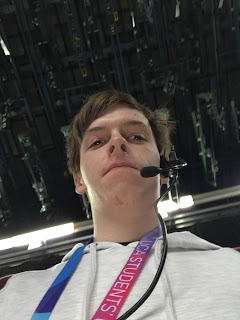
In the beginning I found myself at a bit of a loss as to where I should stand, but after some time I found it effective to stand by the main camera or in the centre of the room, this way if the director asks me a question or there is a problem, I would be in a good place to get around quickly or see what is being spoken about.

One problem I encountered was that other people weren't aware of what my hand signals meant. The main ones I was using were to mark time left e.g. 30 seconds, but the talent/guests couldn't recognise this and as such would not wrap up a section in time. To overcome this I communicated what the signals meant to everyone else before we went on air. 

For next week I need to work on memorising all of my hand signals, and Del said that it is important to brief our talent and guests so that they know what is going on.

Camera Op
As the day went on I got the opportunity to experience the other roles involved in studio production. The first of these was as a camera operator. 

For this role I had to be quite on the ball and make sure I listened carefully to the director. As a camera Op you need to know the ins and outs of your camera. You must make sure that you have set your white balance and exposure/iris to match all the other cameras in the studio (unless there is a good reason why yours is different). 

You need to ensure your camera is in a good position and you need to be ready to move it as your director requests. 
I found this role to be a little bit dull since we were still in the early days of our rehearsals and the director didn't get us to move/adjust our cameras all that often.

I also struggled when they asked me to adjust some of the technical aspects of my camera since I haven't used the studio cameras a whole bunch, and as such I was unsure how to adjust things like my iris.

None the less it was useful to understand the responsibilities of a camera operator, and understand that they have to be just as alert as the floor manager.

Sound
The next role I got to experience was as the sound operator. This was something I had very little experience in but was eager to understand.

I found that like floor managing there are some unspoken rules that you must be aware of. For example you fade up the sound once the countdown reaches 3 so that you are prepared if the presenters start talking early.

As sound op I learned how to adjust mic sensitivities and how to mix sound levels as the tone of peoples voices change throughout the show. I learned the importance of sound-checks and that getting peoples levels to match is not as easy as you first think. 

As sound you must also be aware of who has what mic and be able to keep track of any changes. I also found that sound is quite an independent role as the director will often rely on you to organise and sort out all sound related tasks and issues yourself, and not check for updates very often. I found this quite a new experience as floor managers and camera ops are in constant communication with the gallery, and I had to use my own initiative to fix my mistakes and find out why some mics weren't being picked up.


Talant
Although none of us will be in front of the camera in our actual show, it was still good to learn what it is like to be a talent/presenter/guest.

In this role you rely heavily on the floor manager to tell you what camera you should be looking at and to find out how you should adjust your pacing to account for the time left in the show. 


Since I have done this kind of thing before I didn't find it too difficult. However I dod find it difficult when I had to keep a conversation going in order to fill time. 

I also found it strange and a little difficult not having any communication with the gallery. 

Gallery PA
Gallery PA was a very interesting and high pressure role that I had not experienced before. 
As gallery PA I was responsible for keeping the show on time. I had to prep countdowns before the start of each segment and ensure I had the exact timings of each VT and show segment so that I could let both the floor and gallery know how much time they had to left to prep or round up a section.

Making sure I had exact countdowns prepared at all times wasn't easy but I think I did it quite well, I just need to be more confident and remember that the gallery talkback is always on so try not to speak over others.

VT/Graphics Operator
The VT/Graphics operator was probably the easiest but least interesting role. All I really did in this role was make sure that the correct graphic and or VT was queued up ready to go, then listen to the director to make sure to press play at the right time. That was as high pressured as it gets, as you don't need to make any visual changes like you would as vision mixer, you just let the VT play. Never the less it was a valuable experience and will help me understand the 
responsibility of some of my peers in the live show.

Vision Mixer
Since we had a vision mixing master class last time I was feeling quite confident. I followed the words of my director carefully making sure to keep my eye line and hands in the correct place. 


This meant that I was able to respond to directions quickly and efficiently, remaining calm and adapting if the director changed their mind or decided to mix straight to transmission without preparing the shot first. 

Overall I enjoyed vision mixing and did it efficiently.

Director
Although I have done directing before, I have never directed a Live broadcast in a studio environment with this many cameras, so it was a new experience.

To begin with I followed Del's advice as to which camera angles I should pick. However once I got a feel for the scene we were shooting and gained more confidence Del took a step back. 

I had to use my own judgement to decide what camera angles we should  use, while also thinking ahead to decide what shots to queue up. I did this reasonably well, occasionally cutting to a shot that wasn't queued up in order to keep up with the action on the floor. I did find myself playing it safe now and then by picking shots that looked quite similar. In future I need to be more varied with my shot choices.

Communication is key as the director, especially with the floor manager so you can ensure cameras are re-positioned how you want them and that the floor is prepared or aware of any issues. This was a good learning experience and has taught me how stressful directing can be and that as floor manager I should keep an open but patient line of communication with my director.


2nd Half
For the second half of the show after everyone had been given a chance to experience all the roles, we changed the studio floor to form a presenter led demonstration scenario. Similar to something you would see on a show like Blue Peter. 

For this part I went back to working cameras and floor managing so I could learn how to manage this kind of set up. It was important to listen to the director so you were aware of what part of the action they wanted to follow. 

You must be able to act quickly in this scenario as you can't really predict what the presenters will say and how they will interact with  their objects. Since we have guests like an Etsy seller on our show, who will be bringing in items to show off/talk about, this was a great experience for us. It helped us learn how to react and follow the action at a different pace, and thanks to getting a feel for for our role in the morning, we were all able to perform efficiently.

Overall today was a fantastic learning experience which will help me understand and sympathise with everyones roll during our live show and improve our communication skills.

Thursday, 1 March 2018

As Live Production: Mock Up VT Fine Cut

As Live Production: Mock Up VT Fine Cut


Above is the finished mock up VT my group filmed for the "Old To New" segment of Steal The Style. 

I'm really pleased with how its turned out, my research in to style trends, and how fashion broadcasts are shot is evident throughout. 

The camera angles and mine en scene are really impressive considering we didn't have the greatest lighting conditions or space to work with. I think we really made the most of our location and used it to improve the stylistic qualities and overall look of the shoot. 

The camera angles are just what you would expect to see in this kind of content and having our editor on set helped us leave room for the impressive graphics you see used. 

I'm also really impressed with the editing of this shoot. Although I'm not the editor for this project, much of this is how I would have pictured it if I was the editor and they have also made some bold choices in the shot transitions which I think really paid off and make for a gripping viewing experience. 

Wednesday, 21 February 2018

As Live Production: "Old To New" VT Research

As Live Production: "Old To New" VT Research

As part of my ongoing work as a VT researcher I have been looking in to the new task I was assigned. Since the running order changes that were discussed in the recent production meeting my group had been assigned the "Old To New" VT to re-brand and research. We now want to look at at least one trend from each decade (70's-00's) that we can then present to our audience using models. Bellow is all the research I have undertaken in to the different trends of each decade that we can use. 

This task has helped me improve my skills as a researcher. I have had to visualise each style and work out how plausible and achievable they will be to get models to demonstrate in a studio environment. In some cases, trends overlapped decades sp I used my common sense, and initiative (following the advice and skills I picked up on when researching this role), and making sure to use a variety of sources in order to fact check specifically which decade each trend was most popular in. I hope that this research will prove useful when planning the shoot of this VT.


Trends Through The Decades (George N)

Different era’s had different fashion trends and aspects that made them unique and defined the decade. I’m going to explore the most popular fashion trends from the 70’s right up until the 00’s so that we have plenty of ideas and inspiration for our “Old To New” VT.


70’s Trends
The Hippie-Although this trend started in the late 60’s it really came in to its own in the 70’s. The Hippie style was intended to be very different and stand out from the crowd. Sparked by influences from figures like John Lennon, the Hippie style was designed to stand out and rebel against the capitalist mainstream ideas of fashion that were present at the time.

Hippies would tend to wear brightly coloured tops and other clothing that featured unique and extragrant patterns. Jeans or trousers would tend to be loose fitting and flared at the bottom. It was not uncommon for “Hippies” to customise and “tie dye” their own clothing.

Overall the idea of the hippy was to pair bold outfits with a more casual low maintenance approach to hair and makeup.

Modern Hippie looks tend to pair the look with jackets bags and several other accessories e.g. glasses/bracelets to emphasise the uniqueness of the styl
e.


80’s Trends
More than ever the 80’s was a time of celebrity influence. People would look up to and attempt to emulate the look of their favourite celebs. Long before Rhompers and Onezies stars like Madonna helped to make bodysuits popular. These suits were designed to be understaed yet flattering for the figure. Usually worn under other clothing they were often seen as a simple yet stylish option for recreational activity e.g. workouts, dancing etc, as they focussed on allowing freedom of movement.

Another trend popular in the 80’s was roll neck tops. Made trendy once again by american sweethearts like Brooke Shields, Roll neck tops were focussed on simplicity. Intended to give off that “girl next door” vibe they were a great “go to” option that could be seen to be very stylish. It is important to note as well that in recent years “Roll Neck”/”Turtle Neck” Tops have made a resurgence among both men and women.

When it came to the Men of the 80’s they were presented with a greater yet simpler variety of options than they had before. Jeans were back in but with more brands available than before men had more cuts, colours and styles to choose from (e.g. boot cut, slim fit etc). Boots and smart shoes were put to one side in favour of more practical and comfortable trainers (Reebok style white trainers proved to be some of the most populer). The long Hippy hair of the 70’s wasn’t completely out but was sensiblized and fashioned in to the male ponytail (which again has seen a resurgence in recent years).

Overall we can see that the 80’s had a strong focus on practicality in its styles and trends more than anything. Especially with accessories like “Fanny Packs” booming. And today we see many of these trends being adapted or revived to form things like Rohmpers.


90’s Trends

The 90’s presented a variety of style options for men and women that we still see today. First of all we can’t talk about the 90’s without mentioning denim.Although denim had been present across all the decades we have covered, it didn’t properly take off until the 90’s. Double denim was obviously huge for both men and women, but something that was also huge was overalls.

Traditionally worn for working in, denim overalls jackets and the like became incredibly fashionable. They were easy enough to wear and allowed for easy customisation e.g. using pins/badges, cutting straps, holes, rips etc. It was less about what overalls you wore (since they didn't exactly come in a variety of colours) and more about how you wore them. Often people would deliberately choose to only wear one strap, or wear a bigger size than they needed.

Crop tops also took off in a big way in the 90’s. As it became more socially acceptable for lots of skin to be on show, many women would opt for a crop top in order to show off/compliment their figure.

Fashion for men in the 90’s also took off. The 90’s saw the birth of the flannel shirt. An easy option that came in a variety of patterns and colours to express the individuals style. They could be worn solo, or paired with another top to make a more complete outfit. Flannel shorts are arguably still just as popular today.

In terms of accessories women had costume jewellery like mood rings, but men helped give birth to the bandana trend. A trend that likely originated due to influence from rap and other music stars, it was a trend that had both fashion and practical uses and is still seen today.


00’s Trends

As the world moved in to a new millenium, fashion moved with it, giving birth to a variety of new trends to suite a new generation.

Arguably the biggest impact the early 00’s had on fashion for both sexes was the tracksuit. While tracksuit tops haven’t lasted that well, tracksuit bottoms are still a popular choice for both men and women today; and in the 00’s branded tracksuits were all the rage. Representing the chill yet exciting vibe of the early 00’s tracksuits were available in a variety of colours it helped make a statement and people would coordinate their outfits to accommodate for their chosen colour scheme. They were more often than not branded and likely sparked the idea of a wearing a brand name being a style in itself.

On the other end of the spectrum you have the wild, rebellious and outlandish style of the 00’s punk rocker. As something that could be seen as an extreme evolution of 60’s style, punk rock style sought to reject social norms and push boundaries. Sporters of the style would often customise themselves with vibrant hair colours, piercings etc. The punk rock style saw the birth of ripped jeans, chains, and checkered/tartan patterned clothing. The idea with punk rock was to stand out in as many ways as possible by wearing clothes that made a clear statement, making styles that might have initially been seen as tacky (ripped jeans) or too outlandish (vibrant hair, tartan etc) fashionable.

One other trend that we saw take off in the early 00’s was camo. This trend ranged from camo shorts and vest tops. To “neon pink camo pants for girls”. There was something for everyone and despite the idea of camo originally being to make the user hidden and inconspicuous, the 00’s dod what it does best and rebelled against this by providing a variety of coloured camo clothing for both men and women.

And of course this decade came with its own set of accessories. Girls had large hooped earrings and oversized sunglasses, while guys had things like snapback hats (often worn sideways or backwards to once again stand out from the norm).


Sources


Saturday, 17 February 2018

Critical Perspectives: 16/02/18

Critical Perspectives: 16/02/18

To start the lecture we were introduced to Tracey Ashmore who is there to assist us in the writing and structure of our dissertation proposal.

There are two main types of enquiry: Exploring the relationship between societal views and.... 
-Industry related practices 
-Industry related output

These are the 4 common aims when writing an essay:
1. To measure/gauge the extent of a phenomena
2. To challenge a view/practice
3. To update or recontextualise a view/practice
4. To evaluate a view/practice

Group Activity
Example question: Is relaity Television Taking Over From Soap Operas?

What is wrong with this question?
-It is worded poorly and is a bit vague (a better question would be "to what extent is reality television, taking over from soap operas?"

What details does it lack?
-It lacks depth and it lacks reference to source material. 

Do you think the person knows the answer?
-I think they have a vague idea but not a well thought out answer.

What are the dangers and pitfalls of basing a dissertation off of this question?
-There will not be enough substance, it is very broad, and there is not a lot of theory that can be applied. Also, it's a closed question that only has a yes/no answer.

What research do you think this person has done to arrive at this enquiry?
-I don't think they have done much in the way of research at all.

What research would you advise this person to do, to develop their enquiry?
-Look into theories, pick a time period to focus on, find the origins of each genre. 


Thursday, 15 February 2018

As Live Production: Report Writing

As Live Production: Report Writing

30% of our grade comes from a critical analysis report of our production role.

This essay will be 2000 words and should be made up of research in to your role, and studio production in general. Similar to professional practice, this report should be a guide to how to perform your role. It should give details about the technical aspects, opportunities and challenges faced. But should be kept distant from a diary of your experiences, more of a guide with references to your experience.  

Show the reader that you are able to critically evaluate your work, by understanding critical approaches, informed by referencing your academic reading throughout. 

The report should reference: 
  • The process and methodology adopted
  • Your research into wider context of your chosen area of work and established methodologies and processes-(you must research your chosen role)
  • Contextual information for each project and background
  • Insert your test shoots, scripts, paperwork etc. in to your appendix as an example of your creative process. 
What to include and structuring:
Draw up a list of general areas you will need to cover-try mind mapping
Overal Rule- Tell them what you are going to say(intro), actually tell them (Main Body), recap and summarise what you've told them (conclusion).

Titles and sections to include:
!!!!!!!!!!!!!!!!!!!!!!!!!!!!!!!!!!!!!


Report Format- You need to use a combination of the following:
  • Bullet points
  • Titles heading/subheadings
  • Illustrations/images
  • Page Numbers
  • Foot Notes
  • References
  • Bibliography
  • Appendix 

Sources of information: People; books and other publications; online; events and places.

Always adopt a formal writing style which is "unobtrusive".

Argue your points in the essay by supporting them with evidence.

Avoid Colloquialisms.

SPAG, Avoid overly long sentences/paragraphs, 

Explain things an uninformed audience wouldn't know.

Proof read your work before submission.

Be concise and clear

Avoid simple terms like "basically" or "actually".

Avoid unnecessary repetition and back referencing. 
____________________________________________________________________

Why do a research Report?

It justifies your creative methodologies and choices.

Shows you can make informed decisions.

Shows you can reflect on your work.