Monday, 20 November 2017

Professional Practice: Liaising And Technical Dificulties

Professional Practice: Liaising And Technical Difficulties

Over the past few days I have been submitting documents and talking to the guildhall regarding my commission. However this has been made considerably more difficult due to technical difficulties beyond my control. 


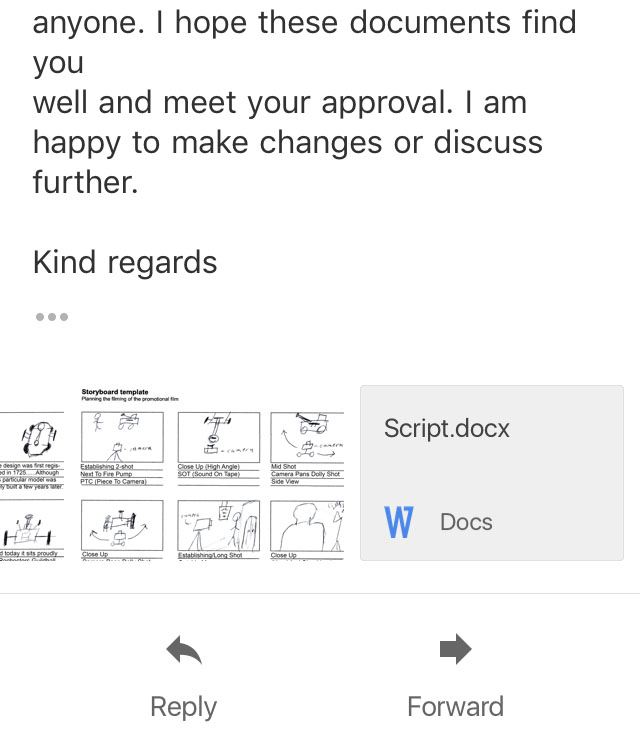
We agreed in our previous meeting that we would send over a basic shot list and or story board on Thursday. I worked hard to prepare both ready for them to look at, and sent them over Thursday morning.  However it would appear that of the several documents I sent, the only one they received was my first script/shot list.


To resolve the issue I tired re-sending these documents several times even using my own personal email account. But technical difficulties permitted causing m to be locked out of my account completely at one point due to server issues. 

The fact that most of my emails haven't been getting through also meant that my request for information on my objects wasn't seen so I made sure to find as much as I could online.

To make up for this I made sure to phone the Guildhall and explain the situation, after the initial confusion was resolved they seemed to understand. 

They informed me that from what they had seen my idea was "right on the money". And although they were busy if I took all my paperwork with me when I start filming they could have another look then. I look forward to starting my shoot. 


I have been sure to maintain regular email contact. 


Commission: Shoot Schedule And Equipment List

Commission: Shoot Schedule And Equipment List

After meeting and continuing to email the guildhall we have agreed on a some shoot days and deadlines. Following on from this I prepared a basic shoot schedule and list of equipment I will need. 

Guildhall Commission Timetable
21st November- Main Shoot day 
22nd/23rd November- Additional Shoot days (if required)
24th November- Rough Cut Viewing 
4th December- Additional Filming Day (if required)
6th December- Fine Cut Viewing 
12th December- Final Deadline.


Shoot Scheduled- Tuesday 21st November
-Arrive about 10AM, meet with Steve to discuss filming locations (that I RECCE'D previously). 
-Start with fire pump, move it and equipment outside. 
-Decide on best positioning for pump depending on light levels and weather. 

-10:30 Set up cameras and other equipment, adjust for light levels etc. 
-10:45 Start filming, initial establishing shots of pump.
-11AM Melissa to arrive and help with PTC shots. Start with Tripod then move on to hand held.
-11:15 Review PTC shots then move back to Fire Pump. 
-11:30-2:30 Main bulk of filming.
  • Follow script/shot list
  • Start with Hand Held shots using Fig Rig and Cannon 100D, Cannon M10 on Tripod as secondary camera angle. 
  • Use Action cam and Dolly for pans.
  • Move action Cam to Gorilla pod for POV shots of movement.
  • Move Cannon 100D over to tripod for additional pans and focus pulls.
  • Finish with establishing shots of museum.
-2:30 Review footage
-2:45-3:15 Help Melissa
-3:20 Film outro PTC, Melissa using cannon 100D and Fig rig
-3:30 Review footage.
-3:45 If no further shots are needed consider moving on to Scramasax. 

Equipment List
-Cannon 100D (primary Camera)
-Cannon M10 (secondary camera)
-Action Cam (Additional Camera)
-Tripod X2
-Road Mic
-Fig Rig
-Gorilla Pod
-Lighting Kit
-Tascam and Sound Kit
-Clip Board With script and story boards.
-Spare Batteries 

Sunday, 19 November 2017

Professional Practice: Commission Research


Professional Practice: Commission Research

As part of this project I needed to kep myslef well informed, not only about the aims of my company, but also about the commission processe in general. As part of my ongoing reserch I watched and analyesed a variety of other similar commissions and a few contrasting ones to see what I could take from them.

1. Sir Cloudesley Shovell's Silver Plate | 100 Objects that Made Kent -Becca Bennet https://www.youtube.com/watch?v=iAxUYB1h-30

This commission uses voice over as its primary method of informing its audience. However there is a lot of what is refered to as dead time, with long pauses in the informative voice over. In my project I would want to hold audience attention bith audibly and visually, as such I would keep a steady pace in my narration with only an occasional pause to ensure thoer attenton doesn't wander. 


The hand held Shots are a little unsteady. Although they do give a nice angel and we have the close up shots in the right place (matching the voice over) as a veiwer I find teh shaky shots a litel distracting. I would use a fig rig or other similar device to help maintaina steady shot and proffecional appearance. i also deiscovered that dollys often make an effective tool especially when panning so I hope to encourperate that in to my work to generate smooth shots and shot transitions. 


There as some good story telling done both visually and audibly. The creator uses sound effects that match the subject matter and help spark the viewers imagination. This is somehting I will consider but I hope to create a similar effect through the use of POV shots.

There is good use of  establishing shots, especially when moving on to a new topic. I plan to at the very least include a wide shot or pan when moving on to a new point in my narration as it hekps ground the project. 


2. Middelheim Museum promo video
https://vimeo.com/45893857

The Quick cuts used in this commission helps maintain the audiences attention well but doesn’t give them much of a chance to absorb visual information. When creating a piace of work that is designed to inform you of course want to keep it interesting but I inyend to eep my cuts at a steady natural pace that matches the voice over and gives my audince a chance to absorb teh information.
Althoug quite fast for a formal piece of work there is steady Pacing in this commission, which as I mentioned is key for maintaiing audiences atention. 

The Text on screen is a very useful tool (like lower thirds) but could have been utalised more effectively in this case. Since there is a lack of voice over the text is the only real inforamtion we have, and it is not on screen for very long which risks lossing its message. I am considering the use of text on screen but intend to make it large enough for all ages to read and more interesting to look at than the generic font used here. But in my project, unlike this one I thinkvoice over would be a more effective tool and text should obly be used to reinforce or provide aditional information that isn't otherwise present. 


This commission blends hand held shots and tripod shots seamlessly. If you can establish a scene nicely with a static shot and then move in to hand held tracking shots when action picks up then you are garanteed to keep atention and pacing. I plan to utalsie both static and hand held/tracking shots in my project as movement is a useful tool. Ti s project is a good example if this done right.

3. Science Museum Group Annual Review
https://www.youtube.com/watch?v=i3gOAntV1_k
The steadt pace of the cuts in this commission is matched well with music. This use of rhythmic editing is a useful skill to have. And since the content in this commssion is exciting it works well. ince my content will likely be more static this technique may be useful to have, but likeley wont prove effective, unless i translate the skill to match voice over as apposed to music.

Voice over was effective here. Sound clips are taken from a variety of interviews keeps things interesting, and in my project I hope to keep the narative moving by having voice over pick straight up from PTC's
The use of POV shots keeps things interesting and is useful especially when targeting a young audience (which i could potentially be aiming at), even though I will be shooting objects I plan to utalsie this skill to keep the project interesting.

4. Natural History Museum

http://www.nhm.ac.uk/discover/the-neanderthal-in-us.html

Great implementation of diagrams to help deliver information. Sometimes it is useful to have a visual aid to reinforce the inforamtion being tokd to an audience. I think there may be room for a diagram in my project but I hope to take it further than this. By recreating the object its self as an animated diagram.

Smooth cutaways and transitions are present in this commission. While I am not sure what cut aways I will be using in my project it is useful to see where they are approprite.

Effective and clear blending of audio/voice over. As mentioned I plan to use voice over in my project but this commsission takes it further tahn i had considrerd by having a backing track throughout which helps maintain audience atention even when there is no talking. While this is a method that I will consider, I am concerened it could prove more of a distraction than anything. 


From looking at the commissions for these museums I can see that there are a variety of common techniques used. Such as voice over, text on screen etc. which I plan to take in to my project.

I have also been able to assess what isn't effective or what works for one commission, but wont work for mine as the themes and aims are too different.

Thursday, 16 November 2017

Professional Practice: Story Boards

Professional Practice: Story Boards

To help visualize the project I also prepared a few hand drawn story boards. These show the basic framing and shot types I intend to use. I took a few extracts from my script and used the story board to show what shots i wish to pair with them. It also demonstrates where I plan to place equipment such as cameras, lights and on screen details. This means I have a slightly more detailed guide to refer to when filming or being questioned by the guildhall about my commission. I was sure to send these documents over for them to look at as well. I prepared separate story boards for both objects. 


Professional Practice: Script/Shot List

Professional Practice: Script/Shot List

Continuing my commission with the guildhall I have developed a clear plan for my initial shoot days. For both their and my benefit I put together a script/shot list that I can use when filming. It lays out the clear dialogue I want to use and the story I want to tell. As well as some ideas for the shot types I want, while also leaving room for cut away's or additional changes suggested by the Guildhall.  

I though carefully, deciding to focus on teh Fire pump, and if I have time the Scramasax as well. Since they both have a vast fascinating history and a huge impact on the local area. There's lots of story telling opportunities. 

Bellow is my plan:


Wednesday, 15 November 2017

Professional Practice: Reading Up

Professional Practice: Reading Up

Before I start writing my script I need to make sure I know what I'm talking about and that I am well informed. 

Since I had decided to look at the Newsham Fire Pump as my primary focus my next step was to make sure I had confirmed my decision with the Guildhall.

I sent them over an email and used this opportunity to request further information on the object so that I could deliver information effectively to an audience and tell a good story. 


As you can see in the above email I contacted Rachel and then Steve asking them to send over any information they had about the fire pump (as they said in the meeting they would be happy to send over anything they had).

I went to them first as since the pump was in their possession I knew they would be well informed. 

I also referred to the pictures I took in the museum and re read over its display details to see if I had missed anything. 


However I wasn't going to stop there, I wanted to make sure I covered a variety of sources, and the next best place was online. 

My first port of call here was to refer back to the 100 objects website as it had multiple segments which had mini articles on the objects history. 


This was a very useful source and helped me get a head start on my script, allowing me to plan my shots around the information I had. I changed some of the language used so that it would flow better as a  story but made sure to stay factually accurate. 

I read up about its condition before it came to the museum which was a key part of the story, I also read the key points that they wanted to be used in schools and was sure to include that in my writing. 


To make sure I covered as much ground as possible I looked at several other websites which were able to provide me useful statistics about the pumps design, history of use and capabilities.

All of this helped me to start creating an informative script.


However the objects weren't the only thing I wanted to learn about, I decided to do some research in to the Guildhall museum its self to learn a little bit more about exactly who I was working for. 

I started by going over the notes that I took when I was listening to the commission/placement pitches a few weeks ago. I was quite intrigued by this opportunity early on and I heard from previous students that they were good to work for. 

According to those who did both the 100 objects and the Young Routes commission last year, they were good to work for. they were interested in the direction that we wanted to go down (as I also found) but ultimately were respectful of creative freedom (provided it matched their agenda). 

I also heard that they were quite helpful when it came to filling out paperwork and gave a detailed report.

This is good to know and I can feel safe in teh knowledge that i am working for a reliable company. 

My next step was to go online and explore the pages on the Medway Council website about the museum. 

   
It was here that I was able to obtain some key facts about the Museum Its self. 

According to the website the building it's self was constructed in the early 17th century dating back a long time like a lot of Rochester. It wasn't always a museum and for a number of years served as a civic building.

This was interesting but what was even more important was its partnership and hosting background.

The museum is described as "by no means quiet" there are often events going on. It hosts interactive learning experiences and sees hundreds of visitors a year, a great many of these visitors being school children. 

The museum (and it's 100 objects exhibits) are often in collaboration with local schools where they have them come in to learn and explore the exhibits up close and personal, often with interactive learning tasks. They have an education officer who I met briefly who sends out information to local schools which often includes projects that have been generated through university partnerships like this one.

I also learned that talks are regularly held at the museum that discuss the historic area and often focus on the people or indeed objects that helped shape Kent. 

This is really useful information to have since I now realize that I will have a bigger audience than I first expected, and I will need to make sure that my project really brings the history to life so that it can grip a wide audience.  

Tuesday, 14 November 2017

Professional Practice: Repot

Professional Practice: Report Writing

When writing a report for this unit there are key things you need to do:
Plan
Research
Demonstrate Understanding
Critically reflect
Look at areas to improve

This report is not simply a diary, it is a piece of industrial analysis. 

Research: Look in to similar work, in my case it could be good to look at websites like the natural history museum, or BBC bite size. Find out how to inform audiences. Demonstrate that you have a clear understanding of your task, your industry and your learning outcomes. 

Learning Outcomes:
ž LO1 demonstrate a developed knowledge and understanding of professional practice 

ž LO2 implement a professional creative methodology 

ž LO3 apply academic conventions and demonstrate effective communication of ideas in written form 

This report should place your micro experience within the macro context of the industry as a whole. Demonstrate your awareness through relevant text, online text, and industry research. 

Be analytical not descriptive!!!

Structure
Beginning- Cover
           Contents page
           Introduction

Middle-    Main Body

End-       conclusions 
           appendixes
           sources 


Things to write about in the main body:
Demonstrate your use of appropriate methodology during your placement/ commission by referencing methodology from research and providing examples of when and how you have/observed it in practice. 

This way you will explore and analyse the ‘bigger picture’ by researching the sector of the industry your placement/commission belongs to – set your own experiences in context. 

Consider referencing typical skills and opportunities there are in the sector you have worked in – what does the future hold in that sector and what challenges? 

Conclusion
Summaries your experiences and what you've learned.
Round off your experience with final references to appropriate sources. 


Demonstrate research in your blog, this is more raw an informal. It will evolve as your work progresses. 

Where as your report will be more formal.
-Avoid colloquialisms
-Write as if your audience knows nothing 
-Use linking phrases to transition to new points/paragraphs